Showing posts with label Ferrari. Show all posts

Sunday, November 27, 2011

Ferrari Classics: 400 series


The 400 series replaced the 365 GT4 2+2 model at the 1976 Paris Salon, and for the first time a model with automatic transmission became available on a Ferrari production car, the 400 Automatic. As with the 365 variant, the model number referred to the swept volume of a single cylinder, whilst the new engine had the same 81mm bore of its predecessor, the stroke was increased to 78mm to give a total capacity of 4823cc. The engine of cars with the automatic gearbox had a factory type reference F 101 C 080. Two banks of three Weber side draught twin choke 38 DCOE 110-111 carburettors were fitted, with twin coil and rear of engine mounted distributors, to produce a claimed 340bhp. The Borg Warner three speed plus reverse automatic gearbox was, perhaps surprisingly for purists, an immediate hit with Ferrari clients, and would account for approximately two thirds of the cars manufactured for the remainder of the 400 into the 412 series production run. In Great Britain the figures were even higher, with the vast majority of purchasers favouring automatic transmission. The power was transmitted from the automatic gearbox through a propeller shaft to a limited slip differential, and from there via half shafts to the independently suspended rear wheels with hydraulic self levelling units.

Although the chassis of the 400 series cars was structurally virtually identical to the preceding 365 GT4 2+2 models, there were nominal differences, which resulted in a new factory reference number F 101 CL 180 for this automatic transmission version. Visually 400 series models can be differentiated from their predecessor by a small body colour spoiler on the lower edge of the nose, five bolt fixing for the five spoke alloy wheels instead of the single triple eared spinner, paired circular rear light assemblies, and the disappearance of the "Cavallino Rampante" from the radiator grille. Inside the seat upholstery was made more sumptuous, and the stitch style and pattern altered, along with minor changes to switchgear on the centre console, and a change of style for the door release catch.

The 400 Automatic continued in production until November 1979, during which time 355 examples were produced in the chassis number range19353 to 28261. As with the 365 GT4 2+2, they were built and fully trimmed at the Pininfarina works in Turin, and then shipped to the Ferrari factory in Maranello for the installation of the mechanical components. Right or left hand drive steering, with power assistance as standard, was available, but as with the other twelve cylinder models of the period, no USA market version was made.

Engine
Type
front, longitudinal 60° V12
Bore/stroke
81 x 78 mm
Unitary displacement
401.93 cc
Total displacement
4823.16 cc
Compression ratio
8.8 : 1
Maximum power
250 kW (340 hp)
Power per litre
70 hp/l
Maximum torque
-
Valve actuation
twin overhead camshafts per bank, two valves per cylinder
Fuel feed
six Weber 38 DCOE carburettors
Ignition
single spark plug per cylinder, two coils
Lubrication
wet sump
Clutch
torque converter
Chassis
Frame
tubular steel
Front suspension
independent, unequal-length wishbones, coil springs over telescopic shock absorbers, anti-roll bar
Rear suspension
self-levelling, independent, unequal-length wishbones, coil springs over telescopic shock absorbers, anti-roll bar
Brakes
discs
Transmission
3-speed automatic + reverse
Steering
power-assisted recirculating-ball
Fuel tank
capacity 120 litres
Front tyres
215/70 VR 15
Rear tyres
215/70 VR 15
Bodywork
Type
2+2 coupé
Length
4810 mm
Width
1796 mm
Height
1310 mm
Wheelbase
2700 mm
Front track
1470 mm
Rear track
1500 mm
Weight
1700 kg (dry)
Performance
Top speed
240 km/h
Acceleration 0-100 km/h
-
0-400 m
14.9 sec.
0-1000 m
25.5 sec.
Note to the Technical Details
The listed details are those published by Ferrari at the model’s presentation. For the models produced in the
participating in these two categories) and Gran Turismo. (the road-going cars, many of which also took part in various international races).
first years no external measures of the body were given, because those could vary from car to car. All models from Ferrari have been divided into three categories: single-seater, Sport/Prototype (the
The year of all the models’ introductions is the debut in competitions for the single-seaters and Sport /Prototypes and the official presentation as far as the Gran Turismo are concerned.


Thursday, October 13, 2011

New Ferrari GT, Geneva


Ferrari will unveil a replacement for the 599 GTB Fiorano at the Geneva Motor Show next March – and the new two-seat supercar will be more powerful and lighter than before, making it one of the company’s fastest-ever models.

Prototypes of the new car, codenamed F152, have already been spotted near the firm’s Maranello base in Italy. They’re said to be putting a new engine and transmission, developed from the FF’s, through its paces.

And that’s one of the keys to the new car’s appeal. Positioned as an out-and-out hyper GT, the new 599 will feature an even more powerful version of the FF’s 6.3-litre V12 direct-injection engine, producing 700bhp. That will make it the most powerful car in the range, with 50bhp more than the FF and 88bhp more than the current car.
Unlike the FF, it won’t feature four-wheel drive – all that power will be sent to the rear wheels through the FF’s seven-speed twin-clutch transmission, with an F1-style electronic differential.
Under the skin, the newcomer will have adaptive dampers and continue to make extensive use of aluminium. A wide mix of alloys will feature in its new chassis, which was developed from the FF’s, but will have a shorter wheelbase.
Together with the extra power, this will ensure a top speed of 215mph and a 0-62mph time of 3.2 seconds – about as fast as a Lamborghini Aventador.

Styling will be evolutionary, taking inspiration from the 458 and FF, with a strip of LED daytime running lights at the front, a 599 GTO-inspired diffuser at the rear and dramatic buttresses either side of the rear window.


by autoexpress

Friday, October 7, 2011

2012 ferrari 458 spider

2012 ferrari 458 spider

2012 ferrari 458 spider


2012 ferrari 458 spider

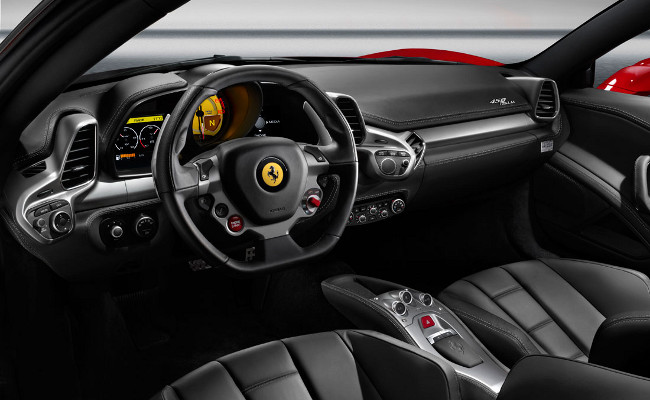
The Ferrari 458 Italia is the best car I have ever driven. You might assume the Italian supercar earns that distinction on sheer performance and sex appeal, but the truth is that the 458 is a much more complete car. Its excellence is in how it combines measured balance with raw capability unlike any other vehicle. The 458 Italia is sophisticated but visceral. Aggressive yet refined. Elegant and brutish. With the Spider, Ferrari aims to add one more contradiction to the 458's achievements: a convertible that's also a coupe.
Ferrari's task in building a Spider is not quite as intuitive as it sounds. The open-air 458 is certainly a predictable and modest evolution of the Italia, but the buyers of the two cars are very different. The average 458 Italia will see most of its action on the weekend, without a passenger, and on shorter trips. Spiders, on the other hand, are more likely to be daily drivers exposed to city streets, often with a passenger in the right seat. More notably, Ferrari asserts that Spider owners drive with a sporty -- not aggressive -- style.
Even with buyers using their cars in an entirely different manner, Ferrari won't compromise any of the intensity in its mid-engine coupe to deliver a droptop version. Despite the fact that the Spider is 30 percent less rigid than the coupe, the spring rates are unchanged. And while the magnetorheological dampers are specifically tuned for the Spider, you won't notice a difference in the ride quality between the two cars. The Spider is every bit as firm, controlled, and focused as the Italia. The steering is just as sharp, the throttle pedal just as responsive, and the suspension just as poised. Twist the manettino to Race mode, however -- perhaps an unlikely move for the less aggressive convertible buyers -- and the Spider can't hide the fact that it's missing a major structural component. With the dampers firmed up, the bumps aren't just felt through the seat. They're seen in a small wiggle of the windshield and heard in the muted rattle of the aluminum chassis. Nothing unusual, but this is the one clear difference between coupe and convertible.
The 458 Spider's retractable roof is a two-piece hardtop inspired by the 575 Superamerica. Like that car, the roof rotates -- rather than folds -- into its stored position. Unlike that car, the 458 Spider uses an aluminum skin instead of glass. Ferrari claims that the 458's hardtop assembly is actually some 55 pounds lighter than the 430 Spider's fabric roof. It adds roughly 110 pounds to the Italia's 3400-pound curb weight.